
Weathering Steel
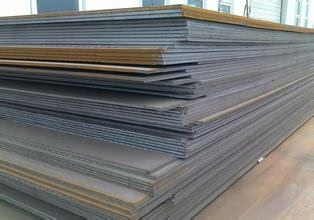
Weathering steel is a group of high-strength, low-alloy steels that, when exposed to weather, form a dense, adherent rust patina that inhibits further corrosion, eliminating the need for protective paint systems.
Material
High-Strength Low-Alloy (HSLA) Steel with Copper, Chromium, and other alloying elements. Common grades include ASTM A588 Gr. A/K, ASTM A606 Type 4, EN 10025-5 S355J0W/J2WP, JIS G3125 SPA-H, GB/T 4171 Q355NH.
Model
Corten-A, Corten-B, A588, S355J2W
Size
Available in all standard mill forms: Plates (thickness 6-100mm+), Sections (beams, angles), Tubes, and Coils (thickness 1.5-12mm).
Thickness
Available across the full thickness range of its product form (e.g., plate: 6-100mm+, sheet/coil: 1.5-12mm).
Standard
ASTM A588, ASTM A606 (Type 4), ASTM A847; EN 10025-5; JIS G3125, G3114; GB/T 4171.
MOQ
15 Metric Tons (varies by product form).
Delivery Time
Standard lead time is 6 to 10 weeks from order confirmation, depending on product form and size.
Long Description
Weathering steel, often referred to by the trademarked name Cor-Ten, is a family of steels alloyed with small amounts of copper, chromium, nickel, and phosphorus. Upon exposure to alternating wet and dry cycles in the atmosphere, these alloys promote the formation of a stable, self-healing oxide layer (patina) on the surface. This patina acts as a barrier, significantly slowing the rate of further atmospheric corrosion compared to unalloyed carbon steel. The characteristic rustic orange-brown appearance is prized in architectural design. Beyond aesthetics, weathering steel offers higher strength than standard carbon steel, allowing for lighter, more efficient structural designs. It is available in all common steel product forms—plates, sections (beams, channels, angles), tubes, and coils—and is primarily used in applications where the patina is desired or where maintenance access for painting is difficult.
Key Product Highlights
Weathering steel develops a protective, stable rust layer that eliminates the need for painting, reducing lifecycle maintenance costs.
The alloy provides higher yield strength compared to standard structural carbon steels (e.g., 50W vs. A36).
The distinctive, evolving aesthetic patina is integral to many architectural and landscape designs.
It offers improved atmospheric corrosion resistance, typically 4 to 8 times that of plain carbon steel.
Suitable for a wide range of structural and artistic applications exposed to the open air.
Product Advantages
Eliminates the recurring costs and environmental impact associated with painting and repainting steel structures.
The protective patina is self-renewing; minor scratches or abrasions will heal over time with continued exposure.
Provides full structural capability with the added benefits of corrosion resistance and distinctive appearance.
Available in a range of international standard grades (ASTM, EN, JIS) with certified mechanical and chemical properties.
Can be welded and fabricated using techniques similar to those for other HSLA steels, with some procedural considerations.
Industry Application
This steel is used for exterior building facades and cladding, bridges (girders, railings), outdoor sculptures and art installations, electrical transmission poles, railroad coal hopper cars, shipping container framing, and un-painted industrial structures.
Technical Specifications
| Parameter | Unit | Plate Grade (e.g., ASTM A588 Gr. A) | Sheet/Coil Grade (e.g., ASTM A606 Type 4) | Structural Section (e.g., EN S355J2W) | Notes |
|---|---|---|---|---|---|
| Carbon Content (C) | % | ≤ 0.19 | ≤ 0.12 | ≤ 0.16 | Lower carbon improves weldability. |
| Manganese (Mn) | % | 0.80 – 1.25 | ≤ 1.65 | ≤ 1.00 – 1.60 | |
| Phosphorus (P) | % | 0.04 – 0.12 | 0.07 – 0.15 | 0.06 – 0.15 | Intentional alloying element for patina formation. |
| Sulfur (S) | % | ≤ 0.05 | ≤ 0.035 | ≤ 0.030 | |
| Copper (Cu) | % | 0.25 – 0.40 | 0.20 – 0.40 | 0.30 – 0.60 | Critical alloying element for corrosion resistance. |
| Chromium (Cr) | % | 0.40 – 0.65 | 0.30 – 1.25 | 0.40 – 0.80 | Critical alloying element for patina stability. |
| Tensile Strength | MPa | ≥ 485 | ≥ 345 | 470 – 630 | |
| Yield Strength | MPa | ≥ 345 (t≤50mm) | ≥ 345 | ≥ 355 (t≤16mm) | Thickness dependent. |
| Elongation | % | ≥ 18 (50mm GL) | ≥ 22 (50mm GL) | ≥ 22 | |
| Corrosion Index (I) | – | ≥ 6.0 | ≥ 6.0 | ≥ 6.0 (per EN) | Calculated value (Cu+Cr+Ni etc.) predicting resistance. |
| Thickness | mm | 6 – 100+ | 1.5 – 12 | Flange/Web: 6 – 40+ | Product form dependent. |
| Width / Section | mm | 1500 – 4000 (Plate) | 600 – 2000 (Coil) | HEA/HEB 100-1000 (Section) | Standard mill dimensions for each form. |
| Surface Treatment | – | As-Rolled (Mill Scale) | As-Rolled or Pickled | As-Rolled (Mill Scale) | Patina forms upon atmospheric exposure. |
| Coating / Finish | – | Unpainted (Intended for Patina) | Unpainted or Pre-weathered | Unpainted (Intended for Patina) | The intended finish is the natural rust patina. |
| Rolling/Condition | – | As-Rolled, Normalized | As-Rolled, Annealed | As-Rolled, Normalized | |
| Standard Example | – | ASTM A588 Gr. A | ASTM A606 Type 4 | EN 10025-5 S355J2W+N | Representative grades for different product forms. |
Packaging & Surface Treatment
Products are packaged according to their form (coils on skids, plates and sections bundled) using standard steel industry practices. Care is taken to avoid contaminating the surface with oils, greases, or dissimilar metals that could disrupt uniform patina formation. The surface is supplied in the as-rolled condition with mill scale. For accelerated patination or specific aesthetic effects, materials can be supplied pre-weathered using chemical or natural exposure processes. The steel is intended to remain unpainted.
Aliases Names
Cor-Ten Steel, Atmospheric Corrosion Resistant Steel, Patina Steel, A588 Steel, Weathering Structural Steel.