SSAW Steel Pipe (Spiral Submerged Arc Welded)
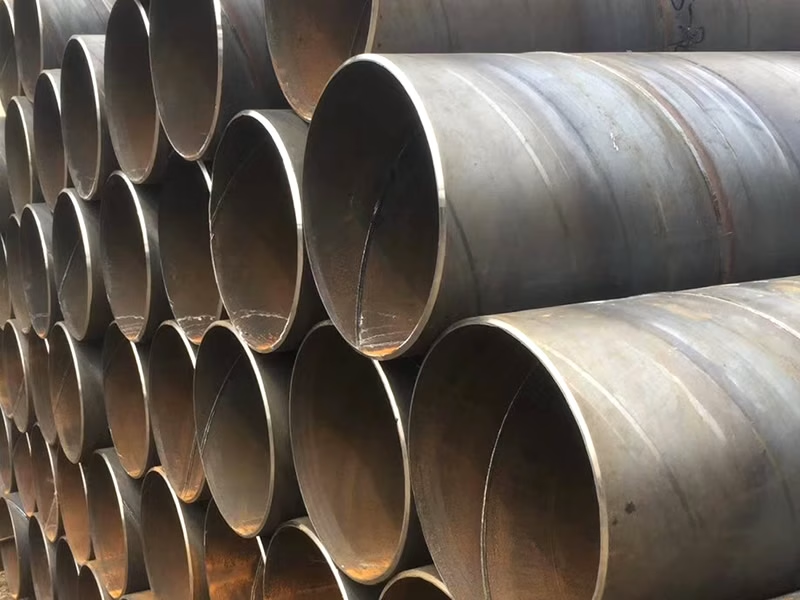
SSAW pipe is manufactured by helically forming and continuously welding hot-rolled steel coil using the submerged arc welding process, producing large-diameter pipes with a characteristic spiral seam.
Material
Carbon Steel and High-Strength Low-Alloy Steel. Common grades include API 5L PSL1/PSL2 (Gr. B, X42-X80), ASTM A139 Gr. B/C/E, SY/T 5037, GB/T 9711 L245-L555.
Model
Spiral Weld Pipe, Helical Weld Pipe
Size
Outer Diameter (OD) range: typically from 20 inches (508 mm) to 120 inches (3048 mm) and larger.
Thickness
Wall thickness typically from 6 mm to 25 mm, with capabilities for thicker walls as required.
Standard
API 5L, ASTM A139, ASTM A252 (for piling), SY/T 5037, GB/T 9711.
MOQ
10 Metric Tons (project-dependent)
Delivery Time
Standard lead time is 8 to 14 weeks from order confirmation, depending on diameter, grade, and quantity.
Long Description
SSAW (Spiral Submerged Arc Welded) pipe is produced by continuously feeding a hot-rolled steel strip at an angle onto a forming mandrel, creating a spiral tube. The longitudinal seam is welded on the inside and outside using the submerged arc welding (SAW) process, where the arc is shielded by a blanket of granular flux. This method allows for the production of pipes with diameters significantly larger than the width of the original coil. The spiral weld design distributes stress circumferentially and offers good resistance to hoop stress. SSAW pipes are known for their ability to be produced in large diameters (typically from 20 inches upwards) and long lengths, making them highly efficient for long-distance pipeline projects. They are commonly used as line pipe for oil, gas, and water transmission, as well as for piling and structural columns.
Key Product Highlights
SSAW technology enables economical production of large-diameter pipes exceeding 100 inches (2540 mm).
The spiral weld seam offers inherent flexibility and can accommodate some degree of bending and soil movement.
Long continuous production runs allow for pipes in extended single lengths, reducing field welds in pipelines.
The submerged arc welding process produces high-quality, high-deposition welds with excellent integrity.
The pipe can be produced with a wide range of wall thicknesses to meet different pressure and load requirements.
Product Advantages
Cost-effective for large-diameter applications compared to other large-OD pipe manufacturing methods.
The ability to use narrower coils to produce wider pipes provides material sourcing flexibility and potential cost savings.
Produced to major international line pipe and structural standards, ensuring material and weld quality.
Suitable for both onshore and offshore pipeline applications, as well as for structural purposes like piling.
Can be externally and internally coated or lined efficiently in-line or at coating yards for corrosion protection.
Industry Application
This pipe is used for long-distance onshore and offshore oil and gas transmission pipelines, water mains, sewer force mains, structural piling for foundations, bridge piers, and as caissons and micro-tunneling casings.
Technical Specifications
| Parameter | Unit | Line Pipe (e.g., API 5L X42 PSL1) | Structural/Piling Pipe (e.g., ASTM A252 Gr. 3) | Water Pipe (e.g., ASTM A139 Gr. B) | Notes |
|---|---|---|---|---|---|
| Carbon Content (C) | % | ≤ 0.26 | ≤ 0.30 | ≤ 0.28 | Max values; actual often lower per chemistry requirements. |
| Manganese (Mn) | % | ≤ 1.40 | ≤ 1.50 | ≤ 1.20 | |
| Phosphorus (P) | % | ≤ 0.030 | ≤ 0.05 | ≤ 0.05 | Tighter control in line pipe grades. |
| Sulfur (S) | % | ≤ 0.030 | ≤ 0.05 | ≤ 0.05 | Tighter control in line pipe grades. |
| Tensile Strength | MPa | ≥ 415 | ≥ 455 | ≥ 310 | Minimum required per respective grade. |
| Yield Strength | MPa | ≥ 290 (X42) | ≥ 310 (Gr.3) | ≥ 205 | Minimum required per respective grade. |
| Elongation | % | See API 5L Table 8 | ≥ 18 | ≥ 25 (Gr. B) | |
| Hardness | HB | ≤ 197 (typical for X42) | N/A | N/A | Often specified for sour service or to meet HIC requirements. |
| Outer Diameter (OD) | mm | 508 – 2540 | 406 – 2540 | 508 – 2540 | Characteristic large diameter range. |
| Wall Thickness | mm | 6 – 20 | 6 – 25 | 6 – 16 | Varies by application; piling often thicker. |
| Length | m | 6 – 18 (Typical), up to 12.2m standard for line pipe | 6 – 18 | 6 – 12 | Limited by transport logistics; can be double-jointed. |
| Surface Treatment | – | Bare, Beveled Ends | Bare, Plain Ends | Bare, Plain Ends | Typically supplied bare for subsequent coating. |
| Coating / Finish | – | Plain End, Beveled End (for welding) | Plain End | Plain End | End preparation depends on application. |
| Welding Process | – | Submerged Arc Welding (SAW), Spiral Seam | Submerged Arc Welding (SAW), Spiral Seam | Submerged Arc Welding (SAW), Spiral Seam | Defines the product type and quality. |
| Standard Example | – | API 5L PSL1 X42 SSAW | ASTM A252 Gr. 3 SSAW | ASTM A139 Gr. B SSAW | Representative specifications for primary applications. |
Packaging & Surface Treatment
Pipes are typically bundled in pairs or small stacks and secured with steel straps. Ends are often protected with plastic or steel caps, especially if beveled for welding. For pipeline projects, pipes are usually supplied bare (with mill scale) to be coated at a dedicated coating facility. For piling applications, they may be supplied as-is or with a simple shop primer. External concrete weight coating or internal linings are applied as per specific project requirements.
Aliases Names
Spiral Weld Pipe, Helical Weld Pipe, SAW Spiral Pipe, Large Diameter Spiral Pipe, Line Pipe.