
High Strength Low Alloy Steel Plate (HSLA)
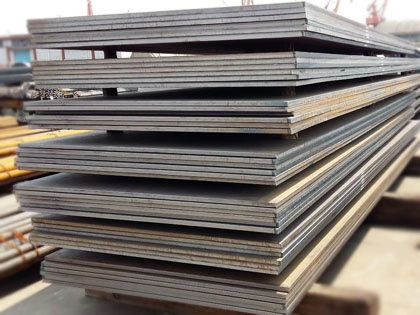
High strength low alloy (HSLA) steel plate is a microalloyed structural plate with enhanced strength and toughness achieved through small additions of elements like niobium, vanadium, or titanium, along with controlled rolling practices.
Material
Microalloyed High-Strength Steel. Common grades include EN 10025-6 S355ML, S460ML; ASTM A572/A572M Gr. 50, Gr. 65; ASTM A709 Gr. 50; JIS G3106 SM490YA, SM570; GB/T 1591 Q355, Q460.
Model
TMCP Plate, Microalloyed Plate
Size
Standard widths from 1500 mm to 4500 mm; lengths up to 25000 mm. Can be supplied as-rolled or cut-to-size.
Thickness
6 mm to 150 mm, with common applications utilizing plates from 10 mm to 80 mm thick.
Standard
ASTM A572, A709, A945; EN 10025-4, 10025-6; JIS G3106; GB/T 1591. Commonly supplied in normalized (N) or thermomechanical (M) conditions.
MOQ
20 Metric Tons.
Delivery Time
Standard lead time is 5 to 9 weeks from order confirmation, dependent on grade, thickness, and quantity.
Long Description
High strength low alloy (HSLA) steel plate is engineered to provide superior mechanical properties compared to conventional carbon steel plates, without the need for heat treatment in many grades. The increased strength, which can range from approximately 350 MPa to over 690 MPa yield strength, is derived from a combination of fine-grain strengthening and precipitation hardening from microalloying elements such as niobium (Nb), vanadium (V), and titanium (Ti). These plates are typically produced via thermomechanical controlled processing (TMCP), which refines the ferrite grain structure to simultaneously improve strength, toughness, and weldability. HSLA plates offer an excellent strength-to-weight ratio, allowing for lighter and more efficient structural designs, along with improved atmospheric corrosion resistance and better low-temperature impact properties than standard carbon steels.
Key Product Highlights
HSLA plates provide higher yield and tensile strengths than standard carbon steel plates of similar thickness.
The product offers enhanced toughness and improved resistance to brittle fracture at lower temperatures.
Good weldability is maintained despite higher strength, often requiring minimal or no preheat.
Controlled rolling (TMCP) eliminates the need for heat treatment, reducing cost and production time.
The superior strength-to-weight ratio enables material savings and reduced structural weight in designs.
Product Advantages
The use of microalloying and controlled processing ensures consistent mechanical properties and good formability.
Full certification to international standards provides reliable design values for engineers and fabricators.
Reduced carbon content compared to heat-treated steels of similar strength improves weldability and cold-forming capability.
Available in a wide range of standardized strength grades to precisely match application load requirements.
The material’s efficiency supports sustainable design through weight reduction and potential for lower carbon footprint.
Industry Application
This plate is used in the fabrication of building frames, crane booms, truck chassis, mining equipment structures, pressure vessels, wind turbine towers, bridge components, and other weight-sensitive or high-stress structural applications.
Technical Specifications
| Parameter | Unit | Common Grade (e.g., S355J2+N) | Higher Strength Grade (e.g., S460ML) | Notes |
|---|---|---|---|---|
| Carbon Content (C) | % | ≤ 0.20 | ≤ 0.16 | Lower carbon in higher strength grades for weldability. |
| Manganese (Mn) | % | ≤ 1.60 | ≤ 1.70 | Primary solid solution strengthener. |
| Phosphorus (P) | % | ≤ 0.030 | ≤ 0.025 | Tighter control in modern HSLA grades. |
| Sulfur (S) | % | ≤ 0.025 | ≤ 0.015 | Very low to ensure good toughness and formability. |
| Tensile Strength | MPa | 470 – 630 | 540 – 720 | Grade dependent range. |
| Yield Strength | MPa | ≥ 355 (t≤16mm) | ≥ 460 (t≤16mm) | Minimum ReH or Rp0.2, thickness dependent. |
| Elongation | % | ≥ 22 | ≥ 17 | Minimum longitudinal value. |
| Hardness | HB | N/A | N/A | Not a primary specified property for structural HSLA. |
| Thickness | mm | 6 – 120 | 6 – 120 | Yield strength decreases with increasing thickness. |
| Width | mm | 1500 – 4500 | 1500 – 4000 | Standard mill rolling capabilities. |
| Coil Weight | MT | N/A | N/A | This product is supplied as plates, not coils. |
| Surface Treatment | – | As-Rolled, Blast Cleaned | As-Rolled, Blast Cleaned | Often supplied descaled for fabrication. |
| Coating / Finish | – | Normalized (N), Normalized-Rolled (N) | Thermomechanically Rolled (TM or M) | Delivery condition is key to achieving properties. |
| Rolling Type | – | N/A | N/A | Parameter is specific to coil products. |
| Standard Example | – | EN 10025-2 S355J2+N | EN 10025-4 S460ML | Representative standard, grade, and condition. |
Packaging & Surface Treatment
Plates are bundled on heavy-duty steel skids with protective wooden strips between layers to prevent surface marring. Bundles are securely strapped with steel bands for stability during handling and transport. For export, they are often wrapped in waterproof, reinforced packaging material. The surface is typically supplied as-rolled with mill scale, or blast-cleaned to Sa 2.5 for immediate priming and fabrication.
Aliases Names
Microalloyed Steel Plate, TMCP Plate, High Strength Structural Plate, Fine Grain Steel Plate, S355 Plate, A572 Plate.