
Alloy steel
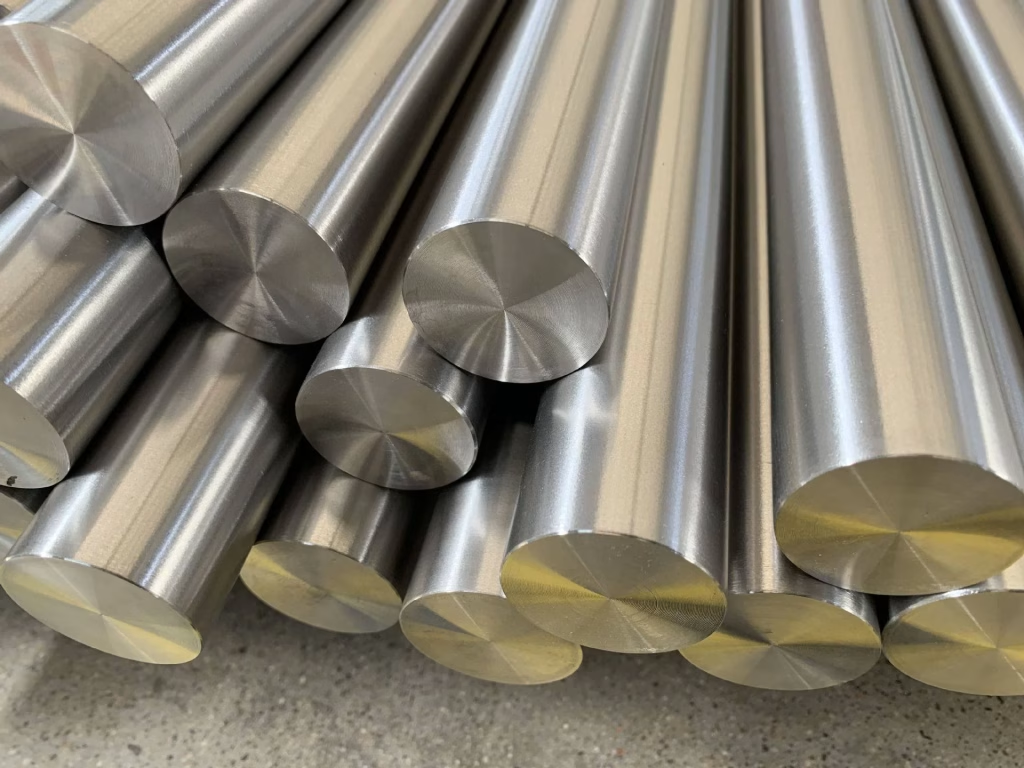
Alloy steel is a category of steel that incorporates significant proportions of alloying elements beyond carbon and manganese, such as chromium, molybdenum, nickel, and vanadium, to achieve specific enhanced mechanical properties and performance under demanding conditions.
Material
Chromium-Molybdenum, Chromium-Molybdenum-Vanadium, Nickel-Chromium-Molybdenum, and other alloy systems. Common grades include ASTM A387 (Gr.11, Gr.22, Gr.91), ASTM A182 (F11, F22, F91), ASTM A335 (P11, P22, P91), AISI/SAE 4140, 4340, 8620, EN 10028-2 (13CrMo4-5, 10CrMo9-10).
Model
Cr-Mo Steel, Ni-Cr-Mo Steel
Size
Available in all standard mill forms. Plates: thickness up to 300mm+; Pipes: NPS from 1/8″ to 48″; Bars: diameters from 10mm to 1000mm.
Thickness
Product form dependent
Standard
ASTM A387 (Pressure Vessel Plates), ASTM A335 (Seamless Pipe), ASTM A182 (Forgings/Fittings), ASTM A829 (Plates), EN 10028-2, ISO 683-1.
MOQ
5 Metric Tons (highly grade and form dependent).
Delivery Time
Standard lead time is 8 to 16 weeks from order confirmation, due to specialized melting, rolling, and mandatory heat treatment cycles.
Long Description
Alloy steel is engineered by adding precise combinations of alloying elements to a base iron-carbon matrix to impart properties unattainable with carbon steel alone. These additions enhance hardenability, strength, toughness, wear resistance, and performance at elevated or cryogenic temperatures. Key alloy families include Chromium-Molybdenum (Cr-Mo) steels (e.g., grades 11, 22, 91), known for high-temperature strength and creep resistance in power plants; Nickel alloy steels for low-temperature toughness; and boron-treated steels for enhanced hardenability. Alloy steels are typically supplied in heat-treated conditions (normalized and tempered, quenched and tempered) to realize their full potential. They are fundamental to industries where component failure under stress, pressure, or temperature is not an option, requiring material performance that is precisely predictable and reliable over decades of service.
Key Product Highlights
Alloy steels offer significantly higher strength-to-weight ratios and better hardenability than carbon steels.
Specific grades are designed for exceptional creep resistance and microstructural stability at sustained high temperatures.
Enhanced toughness and ductility at low temperatures make certain alloy steels suitable for cryogenic applications.
Improved wear resistance and fatigue strength extend component life in heavy machinery and rotating equipment.
The properties are achieved and guaranteed through controlled heat treatment processes.
Product Advantages
Tailored chemical compositions allow engineers to specify materials with exact performance characteristics for critical applications.
Superior mechanical properties often enable downsizing of components, leading to weight savings and more efficient designs.
Controlled heat treatment ensures uniform properties throughout thick sections, which is critical for heavy forgings and plates.
Full material traceability and extensive certification, including hardenability tests (Jominy) for some grades, support rigorous quality assurance.
Available in all standard product forms (plate, pipe, tube, bar, forgings) to serve as integrated material solutions for complex projects.
Industry Application
This material is used for power boiler and steam piping systems (P91, P22), pressure vessels and reactors in refineries (A387 Gr.11/22), drill collars and tool joints in oil drilling (AISI 4140/4145), gears, shafts, and high-strength fasteners, military vehicle armor, and critical aircraft landing gear components.
Technical Specifications
| Parameter | Unit | Chromium-Molybdenum (e.g., A387 Gr.11 Cl.2) | Advanced Cr-Mo-V (e.g., A387 Gr.91 Cl.2) | Nickel-Chromium-Molybdenum (e.g., AISI 4340) | Notes |
|---|---|---|---|---|---|
| Carbon Content (C) | % | 0.05 – 0.17 | 0.08 – 0.12 | 0.38 – 0.43 | Controlled for weldability and strength balance. |
| Manganese (Mn) | % | 0.40 – 0.65 | 0.30 – 0.60 | 0.60 – 0.80 | |
| Chromium (Cr) | % | 1.00 – 1.50 | 8.00 – 9.50 | 0.70 – 0.90 | Key for high-temp oxidation & corrosion resistance. |
| Molybdenum (Mo) | % | 0.45 – 0.65 | 0.85 – 1.05 | 0.20 – 0.30 | Enhances strength at high temperatures. |
| Vanadium (V) | % | – | 0.18 – 0.25 | – | In Gr.91 for precipitation strengthening. |
| Nickel (Ni) | % | – | ≤ 0.40 | 1.65 – 2.00 | In 4340 for core toughness and hardenability. |
| Tensile Strength | MPa | 415 – 585 | 585 – 760 | ≥ 1280 (QT Condition) | Highly dependent on heat treatment condition. |
| Yield Strength | MPa | ≥ 205 | ≥ 415 | ≥ 1170 (QT Condition) | |
| Elongation | % | ≥ 22 | ≥ 20 | ≥ 12 (QT Condition) | |
| Hardness | HB | ≤ 163 (Max) | ≤ 250 (Max) | 302 – 375 (QT Condition) | Often specified with maximum or range limits. |
| Impact Toughness | J | See standard | ≥ 41 (@RT, transverse) | See standard (high at low temp for 4340) | Critical for low-temp and power plant applications. |
| Product Form Example | – | Plate, Pipe | Plate, Pipe, Forgings | Bar, Forgings | Common forms for each grade category. |
| Heat Treatment | – | Normalized & Tempered | Normalized & Tempered | Quenched & Tempered | Condition is integral to achieving specified properties. |
| Primary Service | – | Moderate Temp Pressure Vessels | Ultra-Supercritical Boiler/Piping | High-Strength Structural Components | Defining application area. |
| Standard Example | – | ASTM A387 Gr.11 Cl.2 | ASTM A387 Gr.91 Cl.2 | ASTM A829 4340 (Plate) | Representative material standards. |
Packaging & Surface Treatment
Alloy steel products are packaged to prevent damage and contamination. Plates and bars are bundled with protective separators and strapping. Pipes have protected ends. The standard surface condition is as-rolled or heat-treated mill finish, often with residual scale. For protection during storage and transit, a temporary varnish or rust preventative may be applied. Machined surfaces on bars or forgings are often protected with grease or VCI paper. Due to their alloy content, these steels are generally not galvanized; painting is the standard corrosion protection method after fabrication.
Aliases Names
Chrome-Moly Steel, Cr-Mo Steel, High-Temperature Steel, High-Strength Alloy Steel, Pressure Vessel Alloy Steel, Tool Steel (overlap), Boron Steel.