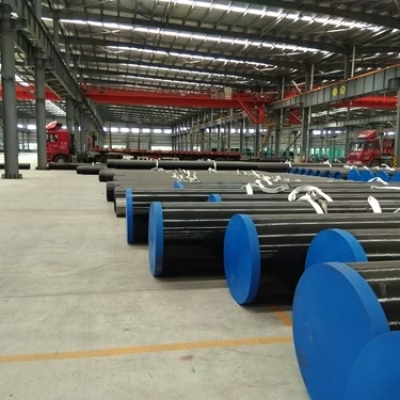
As a world-leading steel producer, Baosteel company brings unparalleled expertise in pipeline steel manufacturing, offering solutions that meet the most demanding requirements of the global energy sector. With increasing pressure on pipeline infrastructure to operate in extreme environments while maintaining safety and efficiency, selecting the right steel grade is critical to project success and long-term reliability.
1. Pipeline Steel Classification and Grade Selection
Grade Selection Based on Application:
| Pipeline Type | Recommended Grades | Key Requirements | Baosteel company Solutions |
|---|---|---|---|
| Onshore Transmission | API 5L X60-X70 | Cost efficiency, weldability, fracture toughness | X65/X70 with optimized carbon equivalent |
| Offshore Subsea | API 5L X65-X80 | Corrosion resistance, high strength, fatigue resistance | Corrosion-resistant grades with enhanced CTOD values |
| Arctic/Siberian | API 5L X70-X80 | Extreme low-temperature toughness, DWTT performance | Grades with -60°C impact toughness |
| Sour Service | ISO 3183 HIC Resistant | Hydrogen-induced cracking resistance, SSC resistance | Clean steel with controlled microstructure |
| High-Pressure Gas | API 5L X80-X100 | Ultra-high strength, deformation capacity | Advanced TMCP processed grades |
| Gathering Lines | API 5L B-X60 | Cost-effective, adequate strength | Economical grades with good weldability |
2. International Standards and Specifications
Major Pipeline Steel Standards:
| Standard System | Key Standards | Grade Range | Baosteel company Compliance |
|---|---|---|---|
| API (American) | API 5L (PSL1/PSL2) | Gr. B to X120 | Full PSL2 compliance with supplementary requirements |
| ISO (International) | ISO 3183 | L245 to L690 | Multiple project specifications including Arctic grades |
| DNV (Marine) | DNV-OS-F101 | Various strength classes | Offshore pipeline certification including fatigue testing |
| EN (European) | EN 10208 | L210 to L690 | CE marked for European market requirements |
| GB (Chinese) | GB/T 9711 | L245 to L690 | National standard plus international equivalency |
Supplementary Requirements:
Sour Service: NACE MR0175/ISO 15156 compliance
Arctic Service: Additional Charpy V-notch testing at low temperatures
Offshore Applications: Enhanced fatigue and fracture mechanics testing
Seismic Zones: Increased deformation capacity requirements
3. Mechanical Properties and Performance Characteristics
Critical Performance Parameters:
| Property | Test Method | Typical Requirements | Baosteel company Capability |
|---|---|---|---|
| Yield Strength | ASTM A370 | 415-690 MPa (X60-X100) | Precise control within ±20 MPa |
| Tensile Strength | ASTM A370 | 520-840 MPa (X60-X100) | Optimal strength-toughness balance |
| Yield Ratio | ASTM A370 | ≤0.93 for strain-based design | Controlled for deformation capacity |
| Charpy Impact | ASTM A370 | ≥200J at -10°C to -60°C | Enhanced for Arctic applications |
| DWTT Performance | API RP 5L3 | ≥85% shear area at design temperature | Advanced microstructural control |
| CTOD Values | BS 7448 | ≥0.15mm for offshore applications | Consistent high-performance results |
| Hardness | ASTM E92 | ≤250 HV10 for sour service | Strict control for HIC resistance |
4. Chemical Composition Design
Element Control Strategy:
| Element | Function in Pipeline Steel | Control Strategy | Baosteel company Expertise |
|---|---|---|---|
| Carbon | Primary strength contributor | Minimized for weldability | Ultra-low carbon designs (<0.06%) |
| Manganese | Strengthening, hardenability | Optimized for balance | Precision control ±0.10% |
| Niobium | Grain refinement, precipitation strengthening | Critical for TMCP | Advanced micro-alloying technology |
| Vanadium | Precipitation strengthening | Controlled addition | Optimized for strength-toughness |
| Titanium | Oxide formation, HIC resistance | Fine-tuned addition | Advanced inclusion shape control |
| Sulfur | Impurity affecting toughness | Ultra-low levels | ≤0.001% for critical applications |
| Phosphorus | Impurity affecting weldability | Strict control | ≤0.012% for sour service grades |
Carbon Equivalent Formulas:
Pcm (IIW): ≤0.22% for excellent weldability
CET (CEV): ≤0.43% for field weldability
CE(Pcm): ≤0.20% for Arctic grade pipelines
5. Manufacturing Processes and Quality Control
Advanced Manufacturing at Baosteel company:
| Process Stage | Technology Applied | Quality Outcome | Baosteel company Advantage |
|---|---|---|---|
| Steelmaking | BOF + RH vacuum degassing | Ultra-low sulfur and oxygen | [S] ≤ 0.001%, [O] ≤ 20 ppm |
| Continuous Casting | Dynamic soft reduction | Uniform microstructure | Center segregation control |
| Hot Rolling | Advanced TMCP | Fine-grained structure | Grain size ASTM 12-13 |
| Cooling Control | Accelerated cooling system | Optimized phase transformation | Precise temperature control |
| Heat Treatment | Online tempering (where required) | Enhanced toughness | Uniform properties lengthwise |
Quality Assurance Systems:
Ultrasonic Testing: 100% full-body inspection
Automated Dimensional Control: Laser-based measurement systems
Surface Inspection: Advanced camera systems for defect detection
Chemical Analysis: On-line spectrometers for composition control
Mechanical Testing: Automated testing with full digital recording
6. Environmental and Operational Considerations
Service Condition Requirements:
| Environment | Critical Factors | Steel Selection Criteria | Baosteel company Solutions |
|---|---|---|---|
| Sour Service | H2S partial pressure, pH | HIC/SSC resistance, hardness control | HIC tested grades with CT ≤ 2% |
| Arctic Service | Low temperature, permafrost | Low-temperature toughness, DWTT performance | Grades qualified to -60°C |
| Offshore | Wave loading, cathodic protection | Fatigue resistance, CP compatibility | Enhanced CTOD and fatigue grades |
| Seismic Zones | Ground movement, fault crossing | High deformation capacity | Low yield ratio (≤0.85) grades |
| High Pressure | Operating pressure > 15 MPa | High strength with adequate toughness | X80-X100 with strain capacity |
| Corrosive Media | CO2, chlorides, microbes | Corrosion allowance or CRA options | Corrosion-resistant alloy options |
7. Welding and Fabrication Considerations
Welding Performance Characteristics:
| Welding Process | Grade Compatibility | Key Challenges | Baosteel company Support |
|---|---|---|---|
| Manual SMAW | X60-X70 | Heat input control | Provided welding procedures |
| Automatic SAW | X65-X80 | Weld metal matching | Matching consumable recommendations |
| Mechanized GMAW | X70-X100 | Productivity vs quality | Optimized procedures available |
| Field Girth Welding | All pipeline grades | Weather conditions, alignment | Pre-qualified welding solutions |
| Repair Welding | Critical grades | HAZ properties | Specialized repair procedures |
Fabrication Guidelines:
Bending: Minimum bend radius recommendations
Coating: Surface preparation requirements
Handling: Protection against mechanical damage
Storage: Environmental protection measures
8. Case Studies: Baosteel company Pipeline Projects
Major Pipeline Applications:
| Project | Location | Steel Grade | Key Challenges | Baowu Solution |
|---|---|---|---|---|
| West-East Pipeline | China, 12,000 km | X80, Φ1219mm | Long distance, varied terrain | High-strength, excellent weldability |
| Arctic LNG Pipeline | Russia, -50°C service | X70, low temperature | Extreme cold, permafrost | -60°C impact toughness |
| Offshore Gas Pipeline | South China Sea | X65, sour service | H2S content, wave loading | HIC-resistant, fatigue-enhanced |
| Trans-Mountain Expansion | Canada, seismic zone | X70, strain-based | Mountainous, seismic activity | Low yield ratio, high deformation |
9. Future Trends and Technological Developments
Emerging Requirements:
Higher Strength Grades: X120 and beyond for efficiency
Enhanced Toughness: Improved low-temperature performance
Digital Integration: Smart pipes with monitoring capabilities
Environmental Compliance: Reduced carbon footprint manufacturing
Baosteel company R&D Initiatives:
Advanced Microstructural Control: Ultra-fine grain development
Corrosion Management: Innovative coating and material solutions
Life Cycle Optimization: Extended service life technologies
Sustainable Manufacturing: Green steel production methods
10. Selection Process and Technical Support
Step-by-Step Selection Guide:
Define Operating Conditions:
Pressure and temperature ranges
Environmental exposures
Regulatory requirements
Establish Performance Criteria:
Mechanical property requirements
Corrosion resistance needs
Fabrication constraints
Grade Selection:
Strength level determination
Toughness requirements
Special service considerations
Verification and Testing:
Prototype evaluation
Welding procedure qualification
Third-party validation
Baosteel company Technical Support Services:
Material Selection Assistance: Expert guidance for specific applications
Welding Procedure Development: Qualification testing support
Failure Analysis: Investigation and prevention services
Technical Training: Client education programs
Conclusion: Partnering for Pipeline Excellence
Selecting the right pipeline steel requires careful consideration of operational requirements, environmental conditions, and long-term performance expectations. Baosteel company’s comprehensive range of pipeline grades, combined with our technical expertise and quality assurance systems, provides the foundation for safe, efficient, and reliable pipeline infrastructure worldwide.
Request Technical Consultation: Contact Our Pipeline Experts for project-specific grade recommendations and technical support.
Download Specifications: Access Our Pipeline Steel Catalog for complete technical data and certification information.
Project Qualification: Submit Your Requirements for material testing and qualification support.
Training Programs: Learn About Our Technical Workshops on pipeline steel selection and welding technology.